
In the last newsletter, The Great AI Work Transfer, I discussed how AI can redistribute work, so junior staff can take on more with AI’s help, and experts can offload routine tasks. That was just the start. We’re now in a completely different phase of the AI curve. In today’s edition, I want to share an observation: being an early adopter of AI tools is no longer a guarantee of success. The real winners will be early transformers: organisations that don’t just try out AI but change themselves to capture its value.
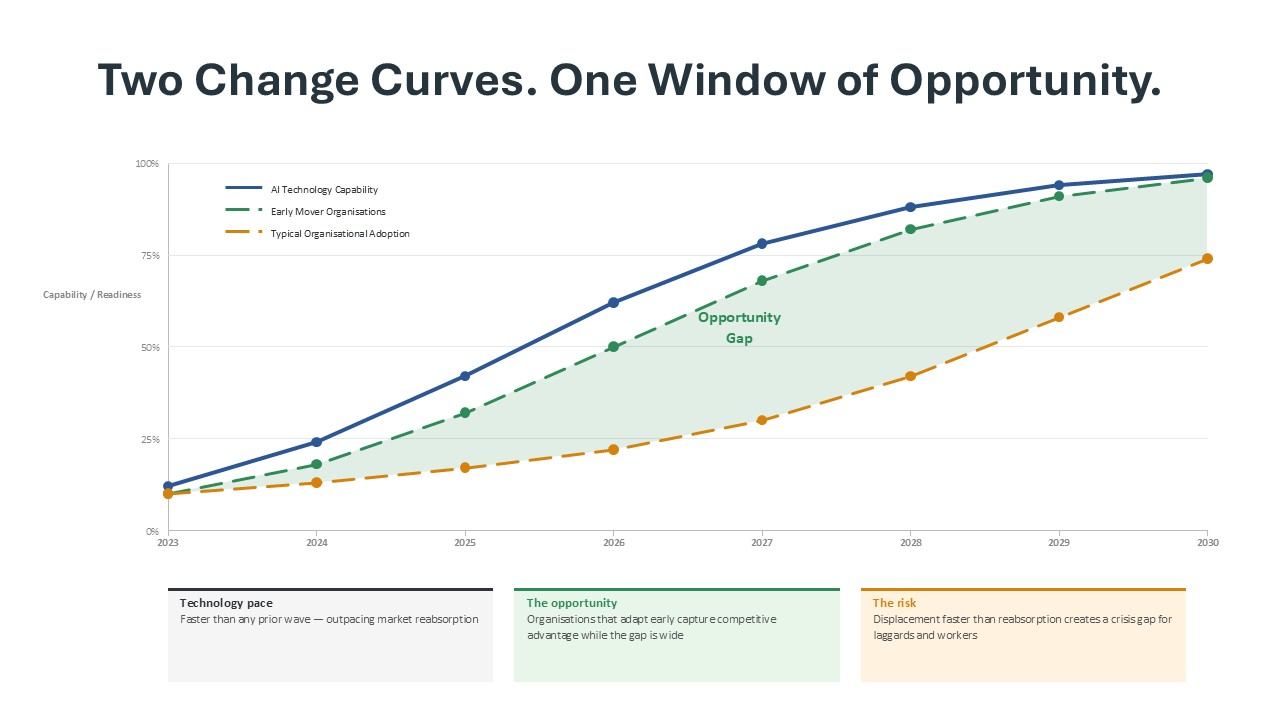
This diagram shows exactly what I mean. The blue curve shows AI’s technology capability, which is developing faster than any previous technology. Think how quickly we went from simple chatbots to advanced generative AI. Then the orange curve showing typical organisational adoption, painfully slow by comparison. The values are indicative, not specific, but these two lines diverge widely over the next few years, leaving a big green gap between them. That green zone is the opportunity for early transformers. It’s a window in which those who adapt early, by redesigning workflows, upskilling staff, and resetting their culture, can capture a leap in performance while the gap is wide.
We’ve seen this dynamic before: early internet adopters and early cloud adopters gained big advantages. But the AI technology pace is unique: it’s clearly outpacing how fast companies can absorb it. Many firms rushed to roll out AI pilots hoping for quick wins. We ended up with a paradox. Nearly eight in ten companies now report using AI in some form, but about the same number (80%) haven’t seen a significant impact on their bottom line yet. Why? Because they haven’t changed how they operate. It’s like bolting a jet engine onto a horse cart: impressive horsepower, but if you don’t redesign the vehicle, you can’t harness it.
To be an early transformer, a company must bridge the gap between what AI can do and what the organisation is ready to do with it. This requires much more than adding a chatbot or an AI plugin here and there. It demands a top-down commitment to reshaping processes, roles, and even incentives around AI. For instance, I often see leaders eager to try the latest AI tool, but hesitant to adjust their team structures or governance to support it. Early transformers are different. They start by identifying processes where AI can have the biggest impact, then reimagine those workflows from end to end. They move team members into new roles (like AI trainers and overseers) and double down on training everyone to be AI-fluent. They shift from isolated pilot projects to cross-functional squads that embed AI deeply in the business. In short, they treat AI not as a shiny gadget, but as a catalyst for organisational change.
The gap between technology and adoption is a double-edged sword. On one side, it offers an unprecedented upside: get it right now and the competition may struggle to catch up. On the other side, it contains hidden risk: if tech capabilities keep racing ahead while you stand still, you could wake up one day dangerously behind. A few early transformers are already capitalising on this gap. For example, a global electronics firm reorganised its support and engineering teams around AI and now reports that its AI agents solve the majority of customer issues independently, cutting response times by 90%. Meanwhile, many peers are still just testing chatbots without altering their call centre scripts. The difference is night and day.
In my view, today’s competitive window is perhaps 18–24 months. During this time, early transformers can gain a multi-year lead in efficiency, innovation, and talent. By 2028 or 2030, I expect that orange adoption curve will catch up a lot of the way to the blue tech curve. By then, simply using AI will be table stakes, and the easy gains will be gone. But between now and then, the gap is yours to seize. The imperative is clear: it’s time to move from adopting new tools to transforming the way we work.
We will look back on this period as one of massive divergence. Some organisations will emerge far ahead; others will struggle to catch up, as the cost and complexity of retrofitting AI later grows. My advice to all IT leaders: become an early transformer instead of just an early adopter. Find the processes to reinvent, rally your people around the change, and close that transformation gap before it closes on you.
I’ll explore what it really takes to become an early transformer, not just an early adopter, in future editions. If you are not already signed up, you can do so here to ensure that you received future editions.
Might I be able to help you?
-
If you want a light-touch IT strategy reset session for your team, reply to this email or get in touch here and let's talk.
-
If you want ongoing support, ask me about coaching or a bespoke engagement.
Thank you for reading, and for your support. I'm really proud of the community that we are building together and that more people are thinking differently about how to define and deliver their IT strategy.
Until next time, remember: IT strategy matters!
Dan - The IT Strategy Coach
