
A few months ago, I wrote about AI transformation and how artificial intelligence is creating the biggest shift in business and technology that many of us will see in our careers.
Since then, I've had dozens of conversations with CIOs, IT leaders and business executives. Almost all of them are investing in AI in some form. Most have piloted Microsoft Copilot. Many are experimenting with AI agents. Some are exploring how generative AI can reshape customer experiences, operations or decision-making.
But there's a problem.
Very few are seeing meaningful business value.
That's not because the technology isn't impressive. Anyone who has used a modern AI tool knows how powerful they can be.
The challenge is that many organisations are treating AI as a technology project when it is actually a business transformation programme.
And that's where things start to go wrong.
The AI Value Gap
Across almost every organisation I speak to, I see the same pattern.
A new AI tool is introduced.
People are encouraged to try it.
A few enthusiasts become highly productive.
Everyone else carries on largely as before.
After six months, leadership starts asking an uncomfortable question:
"We're spending money on AI. Where's the return?"
The answer is usually simple.
The organisation has changed the technology, but very little else.
AI doesn't create value because you switched on a licence.
It creates value when the organisation changes the way it works.
The Six Pillars of AI Business Value
Over the past year I've been developing a framework that helps organisations understand what actually needs to change to generate measurable business value from AI.
At the centre is the outcome everyone wants:
AI Business Value
Supporting that outcome are six critical pillars, and some secure foundations:
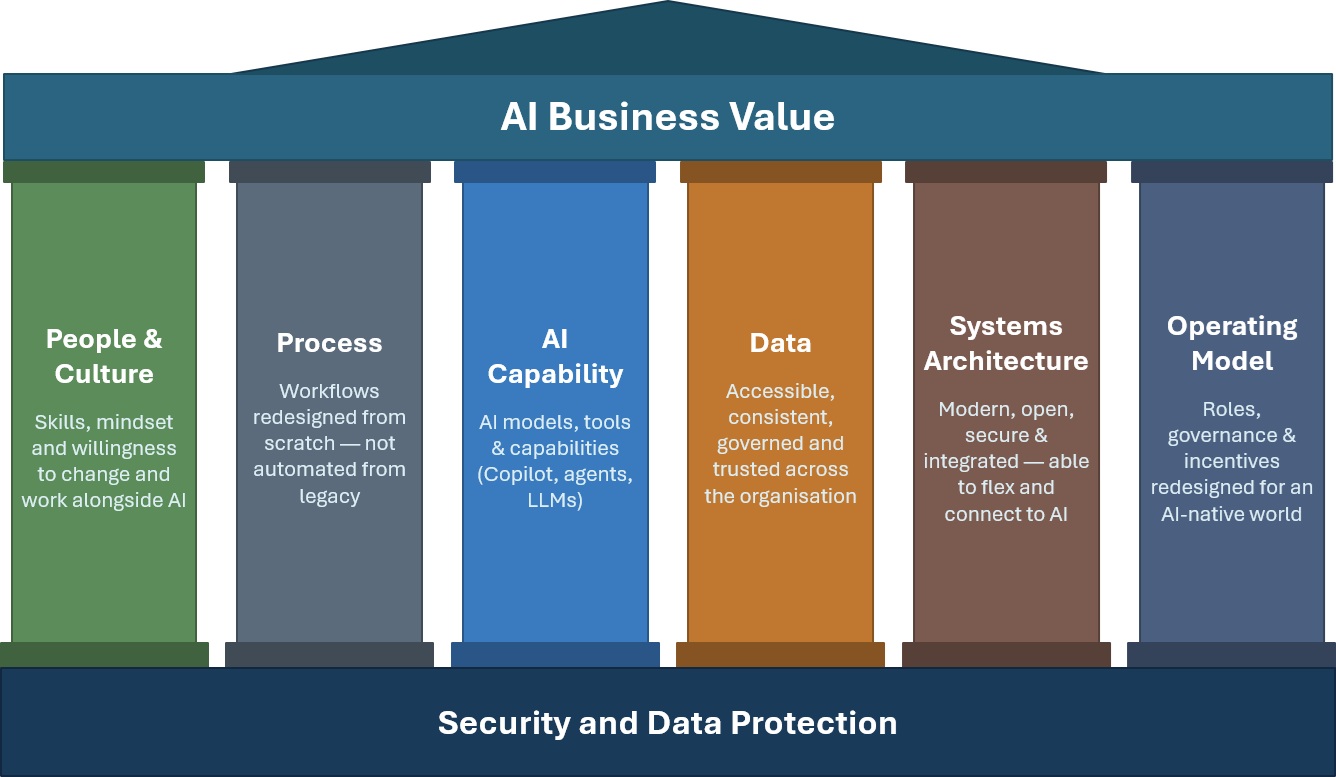
1. People and Culture
AI adoption begins with people.
Employees need new skills, new ways of thinking and the confidence to work alongside AI.
Many organisations underestimate how significant this shift is.
People are not simply learning a new application. They are learning how to delegate work to a digital colleague, assess the quality of AI-generated outputs and redesign how they spend their time.
Without investment in skills, mindset and change management, AI remains a curiosity rather than a capability.
2. Process
One of the biggest mistakes organisations make is layering AI onto broken processes.
If a workflow is slow, heavily manual or constrained by outdated approval structures, AI will only deliver marginal improvements.
The real value comes from redesigning workflows from the ground up.
Instead of asking:
"Where can we add AI?"
Ask:
"If AI existed when we designed this process, how would we do it differently?"
That question often unlocks far larger opportunities.
3. AI Capability
This is the pillar that receives most of the attention.
Copilot, AI agents, large language models and specialist AI applications all have an important role to play.
But tools alone are not enough.
Organisations need the capability to identify use cases, prioritise investments, deploy solutions effectively and continuously improve outcomes.
Technology is essential, but it is only one part of the equation.
4. Data
AI is only as good as the information it can access.
Too many organisations attempt to scale AI while their data remains fragmented, poorly governed or difficult to trust.
Successful organisations invest in making data accessible, consistent and governed.
When employees trust their data, they trust the outputs generated by AI.
Without that trust, adoption stalls.
5. Systems Architecture
AI thrives in connected environments.
Legacy systems, data silos and disconnected applications create significant barriers to value.
The organisations seeing the greatest return are building modern, secure and integrated architectures that allow AI to access information and automate activities across the business.
In many ways, AI is exposing technical debt that organisations have tolerated for years. The business case for repaying that technical debt becomes much stronger if it is suddenly an enabler of AI value.
6. Operating Model
Perhaps the most overlooked pillar of all.
As AI takes on more activities, roles and responsibilities inevitably change.
Decision rights evolve.
Governance models adapt.
Work moves from one place to another within the organisation. Outsourcing decisions change. Team structures and skills are revised.
Performance measures need rethinking.
Incentives must align with new ways of working.
The organisations that treat AI as a strategic operating model change rather than a productivity tool are the ones most likely to realise transformational benefits.
The Foundation Beneath Everything
Beneath all six pillars sits a foundation that cannot be ignored.
Security and Data Protection.
Employees will only embrace AI if they trust it.
Customers will only accept AI if their information is protected.
Boards will only invest at scale if risks are understood and managed.
Strong governance, security controls and responsible AI practices are not barriers to innovation. They are what make sustainable innovation possible and AI value safely realisable.
AI Is Not an IT Project
This is perhaps the most important message of all.
The organisations that succeed with AI will not be the ones that deploy the most tools.
They will be the ones that align people, processes, data, technology and governance around clear business outcomes. And change their operating model to embrace AI.
AI is not an IT project.
It is an organisational transformation programme enabled by technology.
That's a much bigger challenge.
But it's also where the real value lies.
Final Thought
If your organisation has invested in AI but is struggling to demonstrate meaningful business value, the issue may not be the technology itself.
The question worth asking is:
Which of the six pillars needs the most attention?
Because AI value rarely comes from changing one thing.
It comes from changing the system around it.
Might I be able to help you?
- If you want help getting really going with AI, not just playing with it, get in touch.
-
If you want a light-touch IT strategy reset session for your team, reply to this email or get in touch here and let's talk.
-
If you want ongoing support, ask me about coaching or a bespoke engagement.
Thank you for reading, and for your support. I'm really proud of the community that we are building together and that more people are thinking differently about how to define and deliver their IT strategy.
Until next time, remember: IT strategy matters!
Dan - The IT Strategy Coach
